
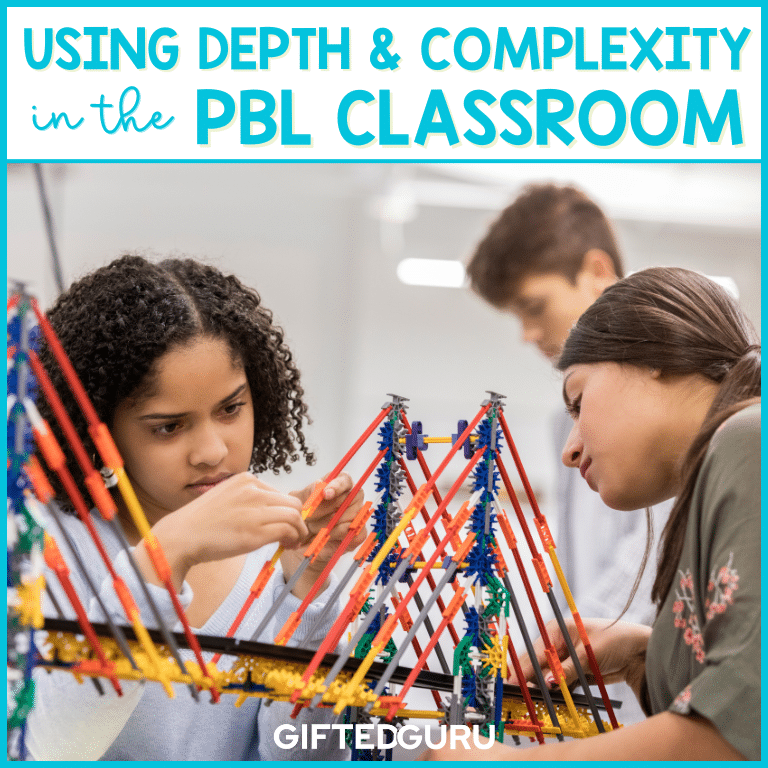
I recently received a thoughtful email from a teacher who attended one of my Depth and Complexity trainings. She is teaching a self-directed, project-based learning course where students design projects around their own passions and interests. This is the first year the course is running full-time, and she is looking for ways to add structure and meaning while still honoring student choice.
Her question is an important one:
How does Depth and Complexity fit into a project-based learning environment?
The answer is that Depth and Complexity works best when it is used as it was intended, as a thinking framework rather than a set of activities.
Depth and Complexity as a Thinking Lens
Depth and Complexity is not something you add on to project-based learning. It is a lens students use to think more intentionally about their work.
In a PBL classroom, students usually have interest and motivation (hopefully!).
The challenge is helping them move beyond exploring what they already know or what is easiest to find. Depth and Complexity provides a shared expectation for the kind of thinking students should be doing, regardless of the topic they choose.
Instead of directing students toward specific content, the framework supports more sophisticated thinking about their content.
Practical Idea: A “Thinking Expectation” Board
Post a small set of Depth and Complexity expectations that apply to all projects, such as:
- Every project must connect to at least one 🌳Big Idea.
- Every project must address one ⚖️ethical or ❓unanswered question.
- Every project must show how understanding ⏳changed over time.
These are not tasks to complete. They are thinking expectations students revisit throughout the project.
Shared Thinking Prompts That Apply to Any Project
Depth and Complexity works well in PBL when teachers use common prompts tied to the framework.
All students can respond to questions such as:
- What 🌳Big Ideas are driving your project?
- What 🌀Patterns are you noticing as you research or create?
- What 🚦systems, rules, or structures influence this topic?
- Whose 🕶️perspectives are missing or underrepresented?
- Why does this topic 📚matter beyond you?
Students may answer through writing, discussion, sketches, or conference conversations. The format can vary, but the thinking remains consistent.
I hope you’re seeing that it’s an integration, not something extra.
Practical Idea: Weekly Depth and Complexity Focus
Choose one Depth or Complexity element as a weekly focus. Every student connects their project to that element in some way during the week.
For example:
- Week 1: 🌳Big Ideas
- Week 2: 🌀Patterns
- Week 3: ⚖️Ethics
- Week 4: 🕶️Multiple Perspectives
This gives students structure without forcing them into the same project path.
Using Depth and Complexity During Student Conferences
Conferencing is where Depth and Complexity really comes alive in a self-directed classroom.
Instead of asking, “What are you working on?” you might ask:
- Which element of Depth and Complexity is strongest in your project right now?
- Where do you think your thinking is still surface-level?
- What question are you wrestling with that does not have an easy answer?
These questions reinforce that growth comes from thinking, not just progress.
Practical Idea: Conference Notes by Framework Element
Keep simple conference notes organized by Depth and Complexity elements rather than by tasks. This helps you notice patterns in student thinking and identify who needs support going deeper.
Checkpoints That Emphasize Thinking
Rather than traditional benchmarks, Depth and Complexity can guide project checkpoints.
Students might pause to:
- Explain how their project reflects one or more 🌳big ideas
- Identify 🌀patterns or 📈trends they did not notice at the beginning
- Describe how new information 📈challenged their original assumptions
- Connect their work to 📚real-world implications or applications
These checkpoints work across all projects and keep rigor high without standardizing outcomes.
Practical Idea: Mid-Project Thinking Audit
Ask students to complete a short “thinking audit” halfway through a project:
- Which elements of Depth and Complexity have I used?
- Which ones have I avoided or ignored?
- What is one way I could push my thinking further?
This encourages metacognition and ownership.
Reflection Through the Framework
Depth and Complexity is especially powerful during reflection. At the end of a project, students can reflect on questions such as:
- Which Depth and Complexity element stretched my thinking the most?
- Where did I struggle, and what did I do about it?
- How has my understanding changed since I began?
Reflection helps students see learning as growth, not just completion.
Supporting Independence Without Losing Rigor
One concern teachers often have about self-directed learning is maintaining rigor. Depth and Complexity addresses this by providing a clear framework for high-level thinking.
Students have autonomy over what they study, but Depth and Complexity ensures they engage with their topic thoughtfully and intentionally. It gives teachers a way to coach thinking without controlling content.
When used as a lens rather than a checklist, Depth and Complexity strengthens project-based learning. It adds clarity, depth, and intellectual challenge while preserving student voice.
That balance is exactly what strong project-based learning aims to achieve.
An Example
One student in a self-directed PBL class decides to design a project around sneaker culture. At first glance, the project seems straightforward. He wants to research popular sneaker brands and design his own shoe.
Using Depth and Complexity as a thinking lens changes the direction of his work.
During an early conference, the teacher asks him to identify the 🌳big ideas connected to his topic. He realizes his project is really about identity, status, and economics rather than shoes alone.
As he continues, the teacher prompts him to look for 🌀patterns. He notices 📈trends in pricing, marketing, and release strategies across brands and time periods. Limited releases and celebrity endorsements emerge as recurring 🌀patterns.
Next, the teacher asks him to consider 🕶️multiple perspectives. He explores how sneaker culture looks different to collectors, athletes, manufacturers, and consumers in different income brackets. This leads him to rethink who benefits from the industry and who is excluded.
Finally, he reflects on ⚖️ethics. He investigates labor practices, environmental impact, and the role of consumerism in shaping demand.
The final product is still a sneaker design, but the thinking behind it is far more sophisticated. Depth and Complexity did not dictate what the student studied. It shaped how deeply he understood it.
Wrapping Up
Project-based learning thrives when students have both freedom and direction. Depth and Complexity provides that direction by clarifying what good thinking looks like, regardless of the topic students choose.
When used intentionally, the framework helps teachers coach thinking rather than manage projects. It gives students a shared language for depth, reflection, and intellectual growth. It also gives teachers a way to maintain rigor in self-directed environments without turning projects into assignments that all look the same.
The key is remembering that Depth and Complexity is not about adding icons or checking off elements. It is about shaping how students approach learning, question ideas, and make meaning over time. (Oh, how I wish everyone could embrace this idea!)
Next Steps for Teachers
If you are experimenting with Depth and Complexity in a project-based or self-directed classroom, a few next steps can help solidify your practice:
- Choose one element of the framework to emphasize consistently for a few weeks rather than trying to use everything at once.
- Build shared reflection questions that students revisit across projects.
- Use Depth and Complexity as the foundation for conferences, feedback, and revision rather than as a product requirement.
For teachers who want a deeper understanding of how the framework works and how to apply it across content areas, I offer an online professional development course focused entirely on Depth and Complexity. The course walks through the thinking behind the framework, common misconceptions, and practical classroom applications. It is designed to be immediately usable, not theoretical, and works well for both traditional and project-based settings.
💡Learn more about the course.
Whether you are refining a PBL course or rethinking how students engage with content more broadly, Depth and Complexity offers a powerful way to support deeper thinking, stronger questions, and more meaningful learning.