
Turning Professional Reading Into Classroom Practice
True Confessions: I’ve bought so many books on pedagogy that I have never read. I had the best of intentions, but it never happened. They just sit on my bookshelf resenting me for buying them and never even cracking the cover. The really frustrating thing is that I bought the book because I wanted the knowledge in them.
I have other books I’ve read but never applied what I learned.
Here’s what I know: Professional books can be powerful catalysts for change, but only if the ideas move beyond reading and into practice. Too often, educators (including me) finish a book with strong intentions, but without a clear structure for implementation, those ideas are difficult to sustain.
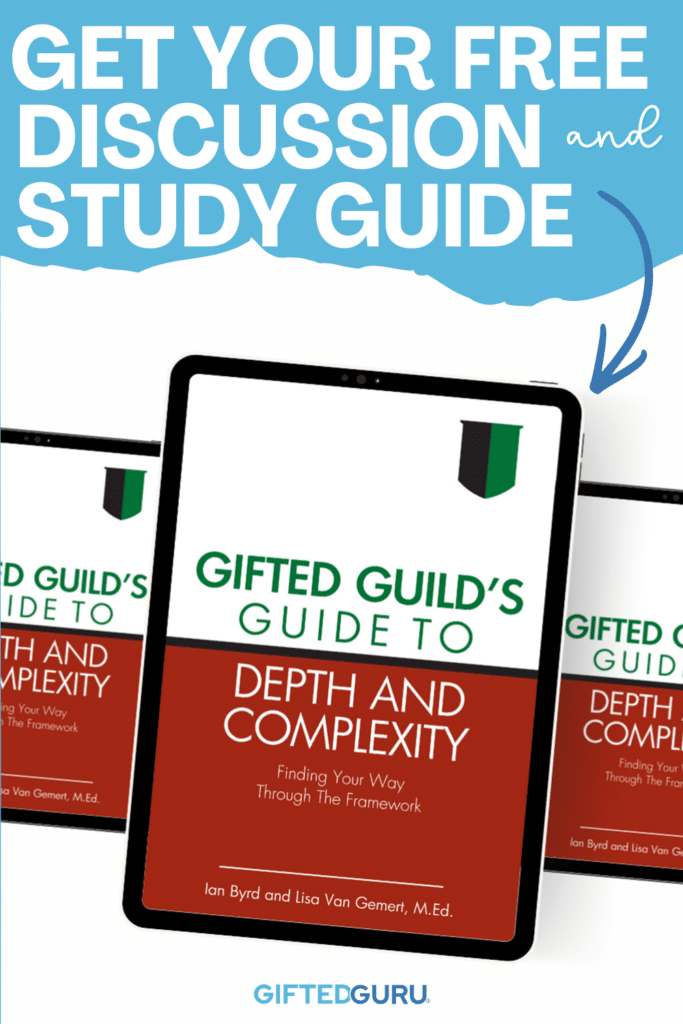
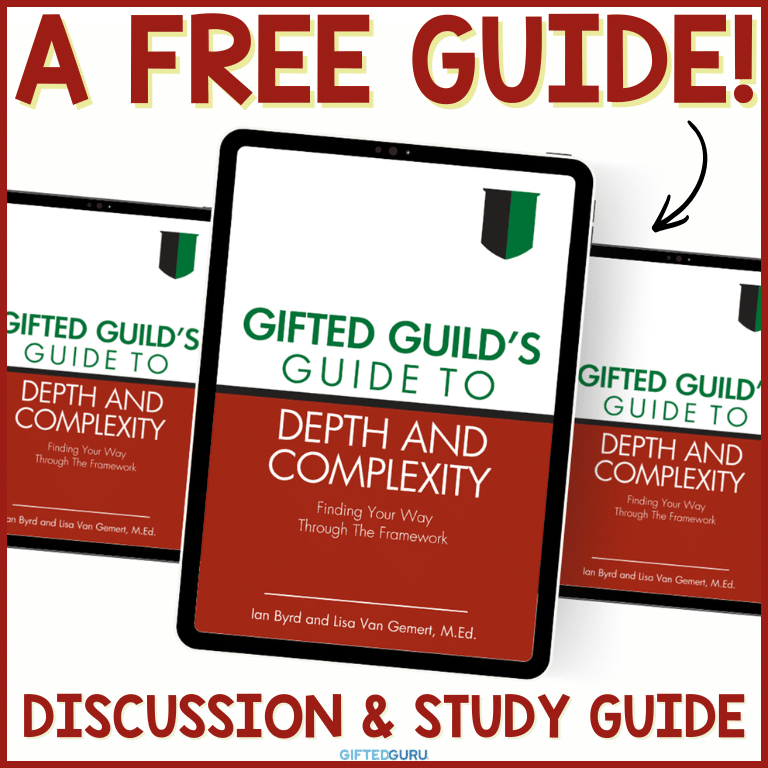
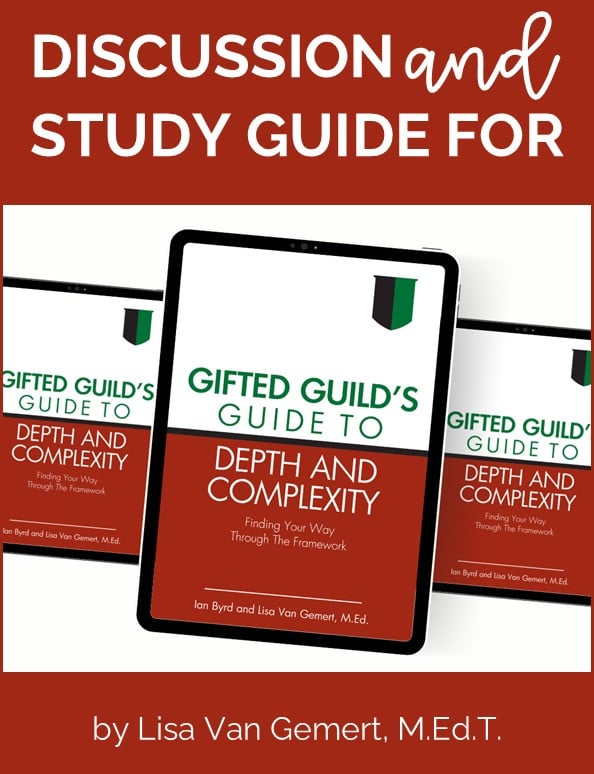
To support meaningful application of Gifted Guild’s Guide to Depth and Complexity, I have created a free discussion and study guide designed to help educators translate the concepts in the book into classroom practice.
I don’t want anyone to spend their hard-earned money on my book, only to never actually use it. Money is too scarce to do that!
So let me tell you a little about the free discussion and study guide.
It is Designed for Individual or Group Use
The guide is intentionally flexible and can be used in a variety of professional learning contexts, including:
- Campus or district book studies
- Professional learning communities (PLCs)
- Small group discussions
- Independent study
In my state (Texas) I can count a book study towards my required CPE hours. I have to have 150 hours every five years, and I always do a book or two as part of that.
For schools and districts, the guide provides a ready-made structure for collaborative learning. It supports focused conversations, encourages reflection, and helps ensure that the ideas from the book are implemented consistently across classrooms.
If you’re an administrator or gifed coordinator looking for a book study that applies practice, this will be perfect for you.
For individual educators, it offers a clear pathway for working through the book with purpose, making it easier to apply new strategies in a thoughtful and sustained way.
Focused on Action, Not Just Discussion
Each chapter of the guide includes:
- Discussion questions to deepen understanding
- Action steps that translate ideas into practice
- Reflection prompts to support thoughtful implementation
Some action steps are practical tasks that can be used immediately in the classroom. Others are “thinking checks” designed to help educators examine their instructional decisions and refine their use of Depth and Complexity.
I used this combination of reflection and action to bridge the gap between understanding the framework and using it effectively with students.
Modeling Depth and Complexity
The guide is built using the Depth and Complexity framework itself. Discussion questions incorporate the prompts and icons, allowing educators to experience the framework as they engage with the content.
Because many of the questions ask educators to consider their own beliefs, experiences, and instructional choices, there is a strong emphasis on 🕶️Multiple Perspectives. This focus encourages deeper reflection and supports more intentional decision-making in the classroom.
Embedded Professional Learning
Throughout the guide, you will find brief explanations of selected prompts and question types. These sections function as a “micro-course,” providing insight into how the prompts are constructed and how they support student thinking.
This added layer of explanation is designed to help educators not only use the questions provided, but also develop their own, strengthening long-term implementation of Depth and Complexity.
Supports Consistent Implementation
I’ve seen a lot of Depth and Complexity mischief. It’s not that teachers are trying to be rogue agents. It’s just that it’s not always easy to find a clear path of implementation.
When a school or district adopts a shared framework, consistency matters. A structured guide can help ensure that educators are not only exposed to the same ideas, but are also working toward common goals.
Using this study guide as part of a book study or professional learning experience can:
- Support alignment across classrooms and grade levels
- Encourage meaningful collaboration among educators
- Promote consistent use of Depth and Complexity strategies
- Increase the likelihood that ideas are implemented and sustained
Even when used by an individual teacher, the guide provides a clear and practical structure for applying the framework in ways that support student thinking, which is the whole point!
Continue the Learning
The guide also includes resources for further exploration of Depth and Complexity, providing next steps for educators and teams who want to deepen their understanding and expand their use of the framework.
Download the Free Study Guide
If you are looking for a way to make professional reading more actionable, this study guide is designed to help.
You can download the free discussion and study guide for Gifted Guild’s Guide to Depth and Complexity and begin using it in your classroom, team, or district.
I hope this guide will support thoughtful implementation and help bring the ideas in the book to life in meaningful and lasting ways.