
Understanding Executive Functioning in Gifted Children
I have spent my entire career, both professionally and as a parent, working to understand how executive functioning shapes the lives of gifted kids. The patterns are unmistakable. A child can think with remarkable depth and still struggle to remember a simple direction. Adults often feel perplexed when the mind that grasps nuance so easily falters in the follow through.
I’m pretty sure you know what I mean.
I mean, come on. You gave us a 45-minute lecture on the importance of classifying dinosaurs correctly, but you can’t get a piece of paper from the backpack to the turn-in basket in class? How is that even possible?
A student once shared with me the most insightful verbal explanation of a math concept I had heard all week. When I asked for the written work, he looked puzzled and then remembered he had slipped the paper into a book “so it wouldn’t get lost.”
The book was now at home.
His understanding was solid. His system for managing materials was not.
This is where executive functioning matters. It is the system that organizes effort, directs attention, and carries ideas across the finish line. It operates alongside intelligence, not inside it. When the two develop at different speeds, confusion quickly follows.
Gifted children frequently experience this mismatch. They may produce sophisticated insights while losing track of time, materials, or steps. What looks like reluctance or indifference is often the result of skills that have not yet caught up to their reasoning. Recognizing this changes the entire conversation.
It shifts us from frustration to understanding.
What Executive Functioning Includes
Executive functioning involves directing attention, planning steps, shifting strategies, and regulating impulses.
In gifted children, these skills can develop at a different pace than their cognitive strengths. A young person may demonstrate exceptional reasoning while still losing track of materials or time.
This mismatch creates misunderstandings at home and in school, particularly when adults interpret the behavior as a lack of motivation.
Asynchronous development often explains the pattern. Strengths in complex thinking grow quickly, while the systems that manage daily tasks develop more gradually. Many gifted learners experience this uneven growth, and it affects how they respond to expectations in classrooms and homes.
How Difficulties Appear in Daily Life
Challenges show up in distinct areas.
- Time may slip away during deep work on a preferred topic.
- Materials may scatter because attention is absorbed elsewhere.
- Information may come in faster than it can be organized.
- Emotions may rise quickly when tasks feel unclear or overwhelming.
These moments reflect effort, not usually/always defiance.
A middle schooler told me she started her homework right after school but looked up to find it was nearly dinnertime and she had completed only one problem. She had followed every interesting idea that crossed her mind. Her time awareness had simply not kept pace with her curiosity.
They signal a need for specific support that aligns with the child’s learning profile. A helpful guiding question is this. Which skill is being asked for right now?
The answer reshapes the conversation and guides the next step.
Building Supportive Structures
- Support works best when it is consistent and responsive (rather than reactive).
- Predictable routines reduce decision fatigue and clarify expectations.
- Short-term aids such as check-ins or simple reminders can ease pressure while new habits develop.
- Tools like checklists, visual models, or verbal cues help students pause and reorient themselves.
Independence grows gradually through these structures. The goal is not perfection. It is steady progress toward managing responsibilities with greater confidence.
This will be individual to the child. Every child will have different struggles (and different strengths that can actually cause problems!).
A gifted fifth grader once showed me a detailed plan for a history project. It had color codes, advanced vocabulary, and a thoughtful thesis. The project was due in two days, and none of it had made it onto the actual poster. His desire for the perfect opening sentence kept him from beginning at all.
Creating Environments That Foster Success
A well-designed environment strengthens executive functioning.
- Streamlined workspaces reduce distraction.
- Clear examples of finished work limit uncertainty.
- Tasks that appear simple are often made up of multiple steps, so breaking processes into smaller actions supports follow through.
These adjustments create conditions that allow gifted children to direct their abilities productively.
During a writing assignment, a student produced a sentence that stretched nearly the length of the page. Charles Dickens would have been envious.
He wanted to include every idea that came to him at once. When asked to separate the thoughts into smaller pieces, he became overwhelmed. His conceptual thinking moved too fast for his organizational skills to match.
The issue could have been resolved had I given more discrete task instructions with constraints (Please make your sentences no longer than 15 words or Make sure your ideas are each in a separate sentence.)
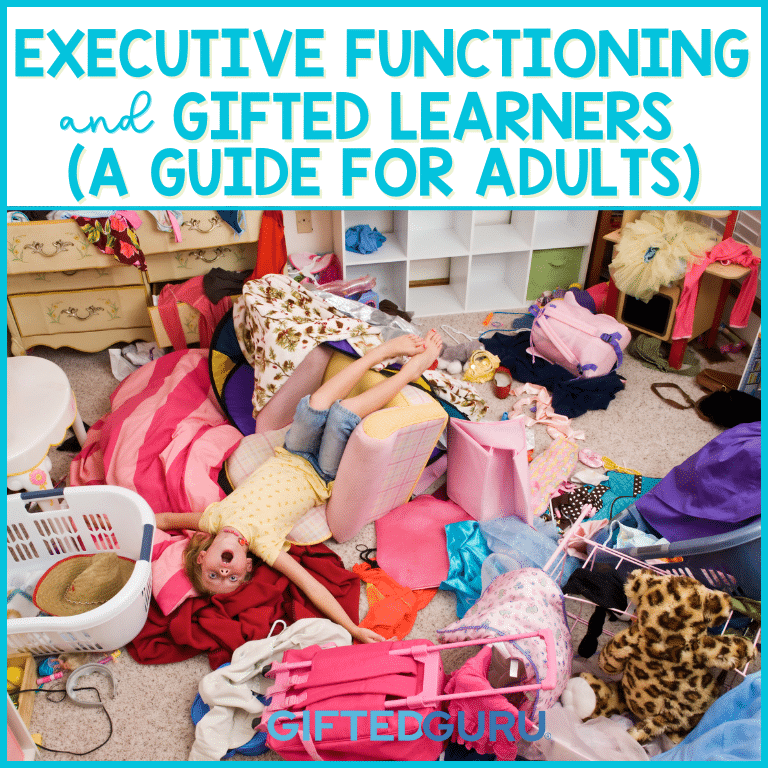
This same dynamic happens at home. “Go clean your room” sounds like a pretty clear direction, but to a child struggling with executive function, it’s a seemingly endless open-ended set of a billion tasks that feels impossible.
Breaking it down into small pieces with celebration of those small wins turns a fight waiting to happen into a completed task.
Moving Forward
It’s crucial to understand this: Executive functioning challenges do not diminish giftedness.
They identify areas where thoughtful support can make a meaningful difference. By understanding how these skills develop and by creating systems that match what gifted learners need, adults help students thrive both academically and emotionally.
Small changes, sustained over time, build the foundation for long-term success. This approach fosters resilience and strengthens the child’s trust in their own abilities.
You can acknowledge the child’s challenges AND their giftedness. They are not in opposition to each other.
Learn More about the Social and Emotional Needs of Gifted Kids
I hope this article has been useful. If you’d like to learn more, I have an entire course on mastering the social and emotional needs of gifted kids, including a full module on executive function.
💡Learn more about the course.